Google · User Research to Launch · 2026
Simplifying Campaigns with AI
An AI-powered redesign of Google's campaign management workflow. Reducing a fragmented, manual process into a centralized, guided experience.
- Role
- Lead Product Designer
- Team
- 10+ cross-functional partners
- Timeline
- 6+ months
- Platform
- Web
- Tools
- Figma Notebook LM Gemini
Introduction
One Market Calendar (OMC) is a centralized marketing hub designed to help 900+ users seamlessly plan, execute, and scale high-impact campaigns.
I led this project end-to-end across research, design, and implementation, collaborating closely with 10+ partners across product, engineering, and delivery.
The impact
Across the full campaign setup flow
With AI-assisted field completion
Per campaign workflow session
"Looks much more aligned with other Google tools and the side navigation is great."
"I love the look of it though. I really do. I think it's a huge improvement from what we currently have — it's such an improvement from a visual perspective."
Key features
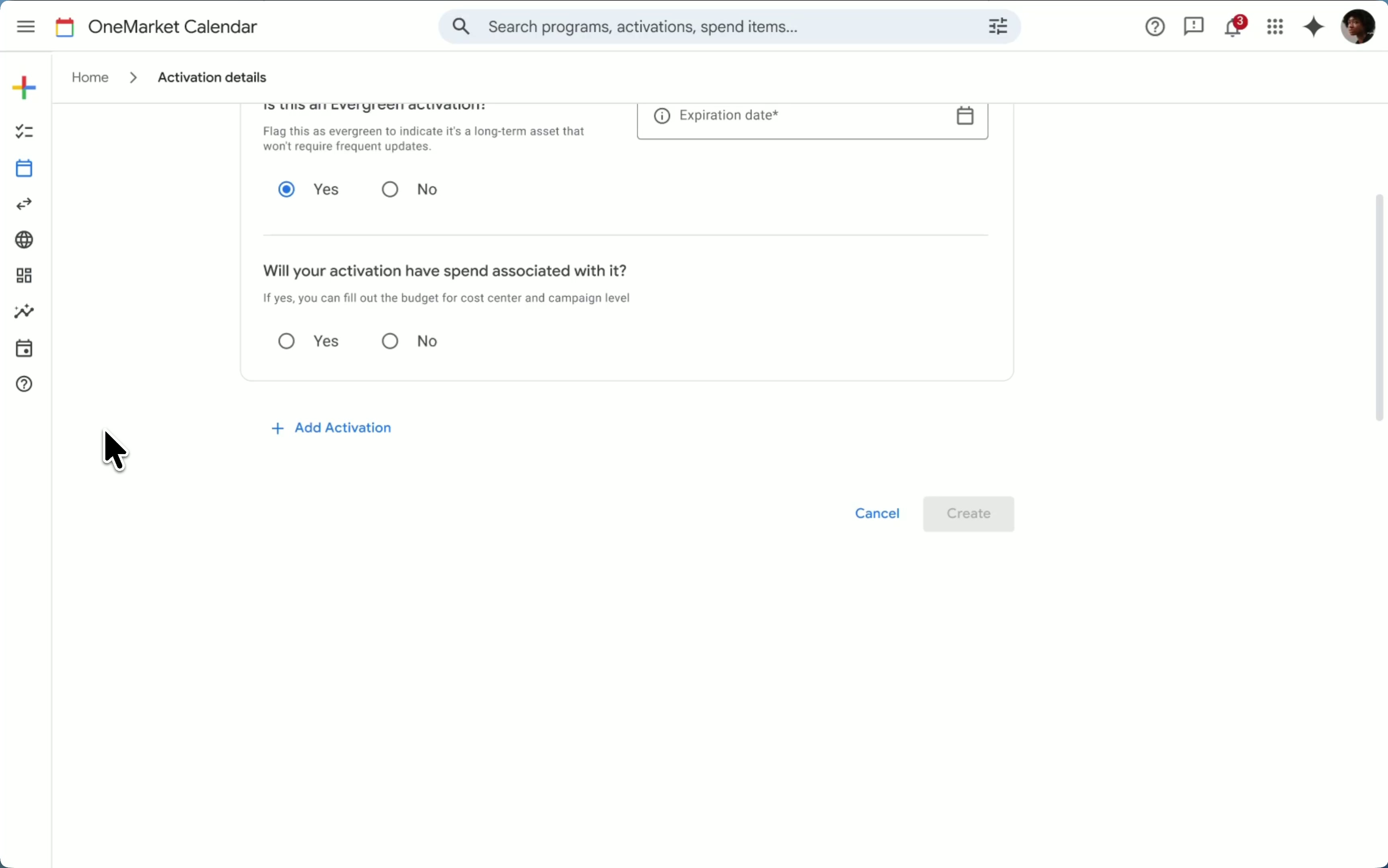
Dynamic input fields
Provides a guided experience by adapting the interface to user selections, progressively revealing only relevant input fields.
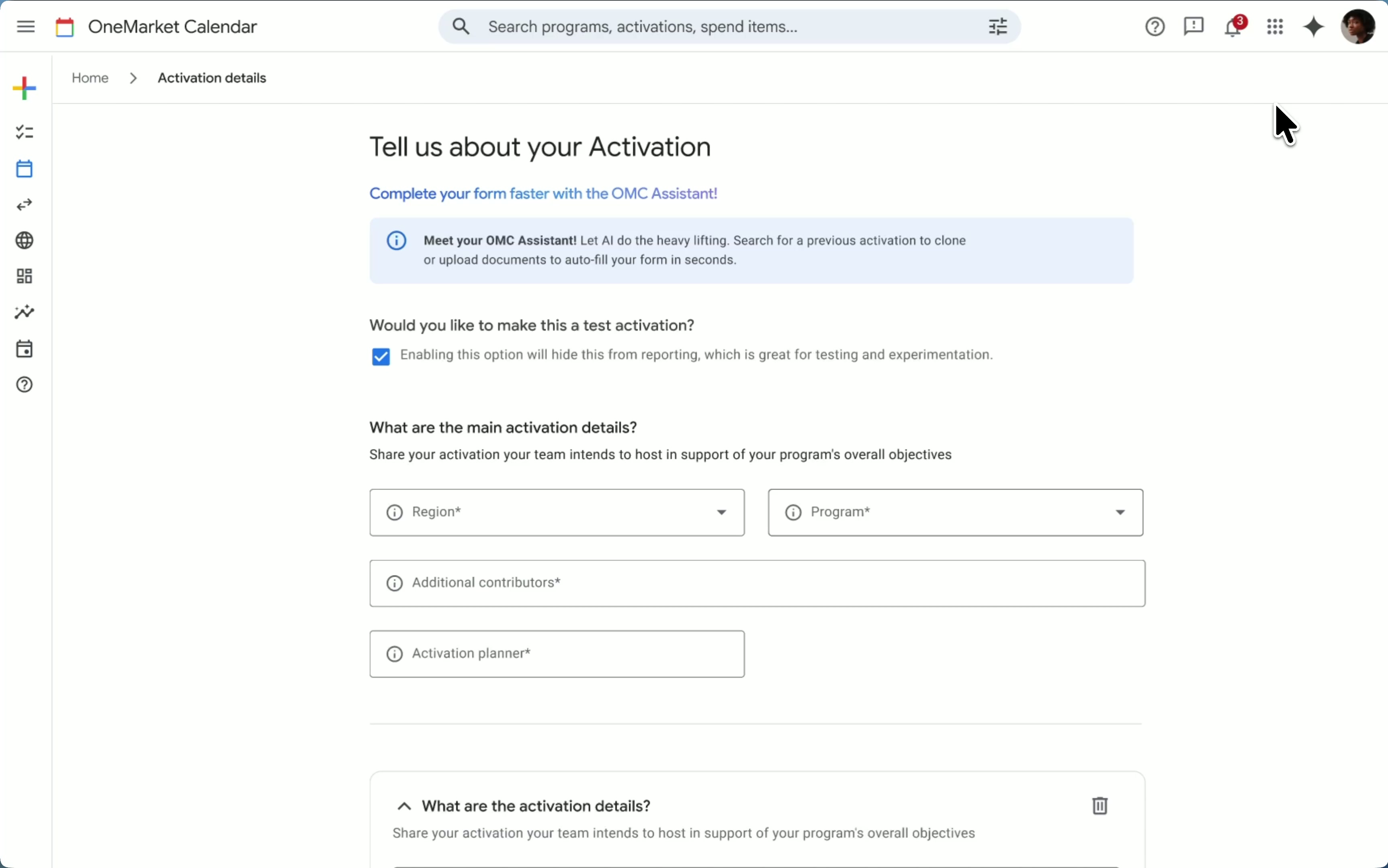
Gemini as a copilot
Integrated Gemini into the workflow to answer questions, explain fields, and suggest correct inputs.
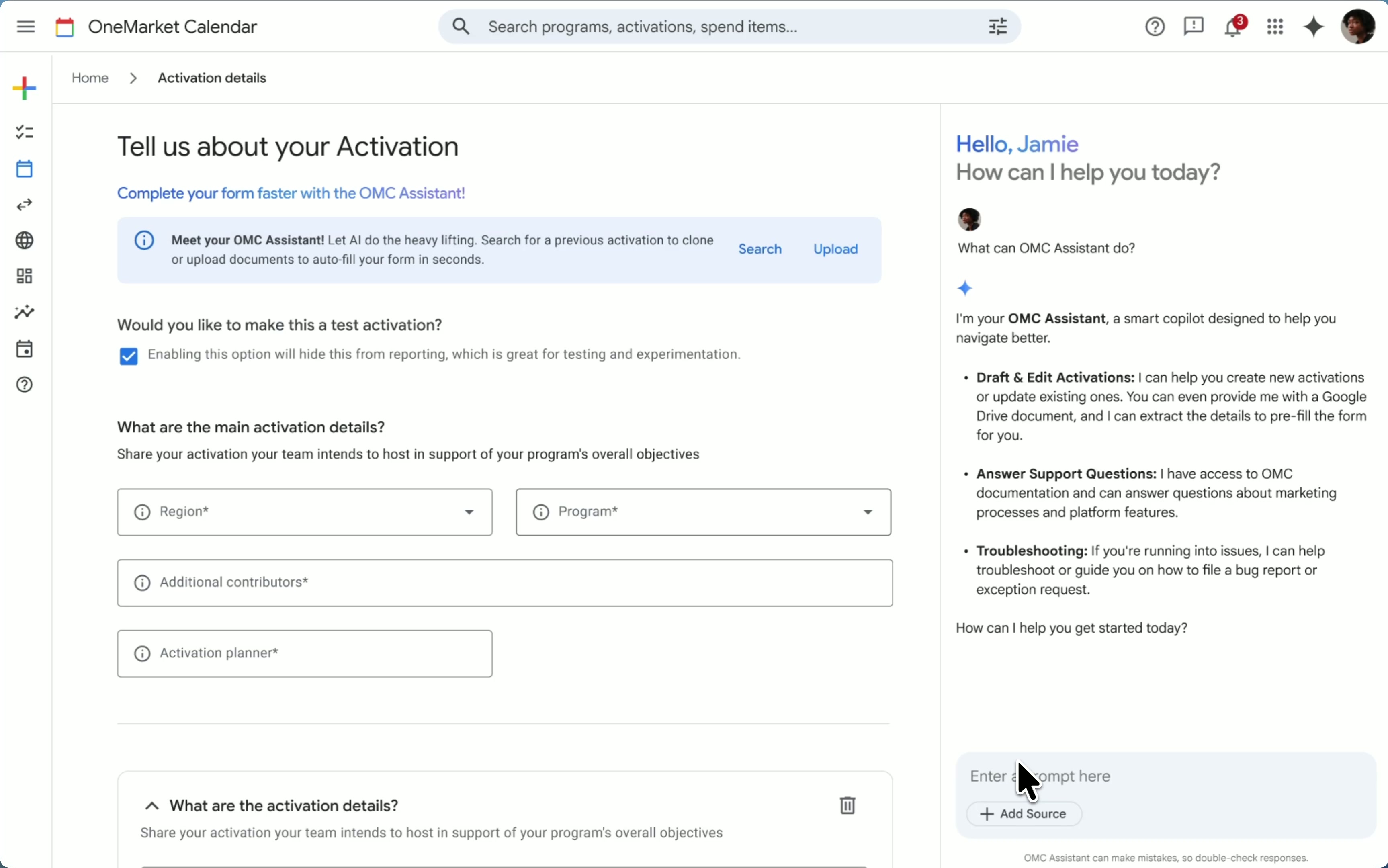
AI auto-population
Integrated Gemini so users can upload a document to auto-fill the form, eliminating manual typing.
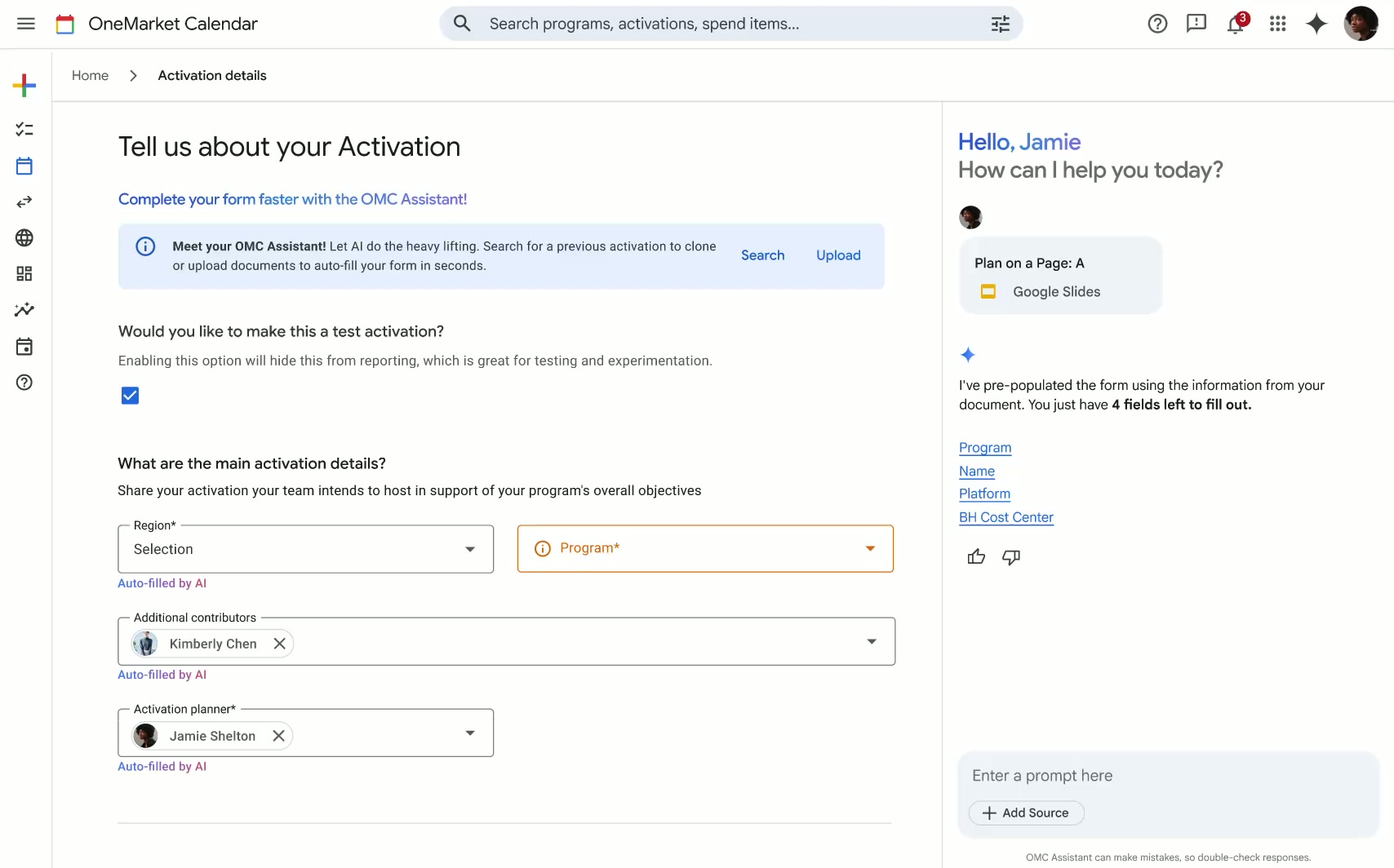
Missing field highlights and real-time guidance
Highlights missing fields inline to reduce errors and prevent workflow interruptions.
Measuring success
A side-by-side look at the workflow before and the UX impact after launch.
Before
Disconnected tools
6+ disconnected tools to plan and manage campaigns.
Lack of automation
Re-entering duplicate details across multiple systems.
Complex workflows
10–20 minutes lost per session navigating tools.
After
Centralized platform
Unified everything into a single campaign hub.
AI automation
Auto-fills forms from briefs with 80% accuracy.
Guided experience
Inline guidance and progressive fields reduce steps by 92%.
My role
I led end-to-end product design from discovery to delivery, focusing on several core areas of responsibility:
- Product Design: Led end-to-end research, prototyping, and handoff.
- UX Research: Identified core workflow inefficiencies.
- AI Chatbot: Designed AI-driven chatbot interfaces.
- Usability Testing: Validated designs through iterative user testing.
- Collaboration: Partnered across product, engineering, and delivery.
The problem
Managing a campaign required navigating 6+ disconnected platforms. Without workflow integration, constant data duplication cost teams 10 to 20 minutes per session in context switching.
6+
disconnected tools
10–20m
lost per session
0
workflow automation
Why AI made sense
Rather than optimizing manual data entry, I redesigned the workflow so AI extracts information from uploaded briefs and pre-populates the form.
Marketers shift from entering data to reviewing AI-generated content, reducing effort while maintaining control.
Automation vs. control
Fully automating campaign creation saved time but reduced trust. I introduced AI as an optional side panel that generated a starting point, allowing marketers to review and refine campaign details before submission.
Flexibility vs. reliability
Campaign briefs varied in structure, so I prioritized extracting the most common fields first to improve reliability while supporting future expansion.
Innovation vs. familiarity
Rather than introducing an entirely new workflow, I embedded AI into the existing campaign creation experience using Google Docs as a familiar interaction model. This reduced context switching and lowered the learning curve for marketers.
From fragmentation to focus
To understand where time was going, I mapped out the full campaign workflow and identified three consistent patterns:
Disconnected tools
Users switched between multiple systems.
Lack of automation
Manual data re-entry across platforms.
Complex workflows
The system lacked intuitive usability.
How Might We
How might we help marketers complete campaign workflows faster, without manual data entry and tool switching?
The Old Experience: Built for Systems, Not Marketers
It was complex and hard to use, creating a fragmented workflow with severe data overload.

Users
Expressed
Frustration
Feels Like a
Backend
Tool
Designing the future workflow
To address the issues I uncovered, I focused on three key areas of improvement:
Centralized platform
Unified essential features into a single hub.
AI automation
Integrated Gemini to eliminate manual setup steps.
Guided experience
Refreshed the UI to ensure an intuitive workflow.
Reflection
Owning this project end-to-end taught me that meaningful product improvements come from understanding the entire ecosystem, not just individual interactions.
By aligning user needs, business objectives, and AI-powered capabilities into a cohesive workflow, I was able to create a more intuitive and scalable experience.


